
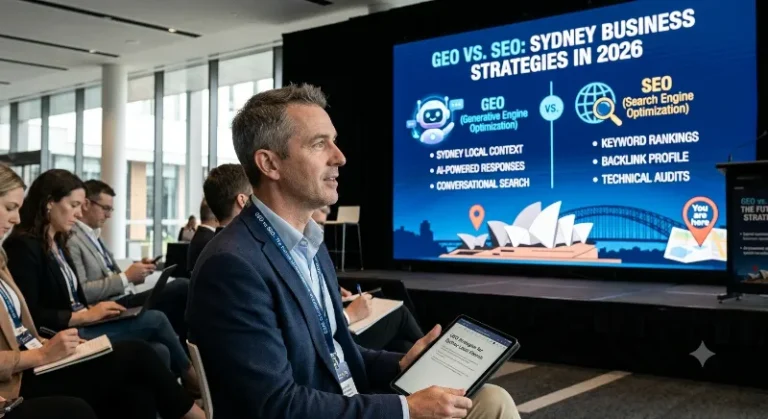
Search is changing faster than most Sydney businesses realise.
For years, SEO was about ranking on Google, getting clicks, and turning website visitors into customers. That still matters. But in 2026, customers are no longer relying only on traditional search results. They are asking ChatGPT for recommendations, using Gemini inside Google, reading AI Overviews, checking Perplexity citations, and expecting direct answers before they ever click a website.
This creates a new challenge for small businesses in Sydney.
It is no longer enough to simply rank on page one. Your business now needs to be understood, trusted, cited, and recommended by both search engines and AI systems.
That is where GEO comes in.
GEO, or Generative Engine Optimization, is the process of optimising your online presence so AI search engines can understand your expertise, extract your answers, and potentially include your brand in AI-generated responses.
SEO is not dead. In fact, strong SEO is still the foundation. But Sydney companies that want to stay visible in 2026 need to understand how SEO and GEO work together.
Quick Answer: What Is the Difference Between GEO and SEO?
SEO helps your website rank in traditional search engines like Google. GEO helps your business become visible in AI-generated answers from tools like ChatGPT, Gemini, Claude, Perplexity and Google AI Overviews. SEO focuses on rankings, clicks, technical health and content relevance. GEO focuses on clarity, authority, structured information, entity recognition, source credibility and answer extraction. In 2026, Sydney businesses need both: SEO to rank, and GEO to be cited, recommended and trusted by AI search systems.
What Is SEO?
SEO stands for Search Engine Optimization. It is the practice of improving your website so search engines can crawl, understand, rank and display your pages for relevant searches.
For a Sydney small business, SEO usually includes:
- Keyword research
- Local SEO
- Google Business Profile optimisation
- Website speed improvements
- On-page content optimisation
- Internal linking
- Technical SEO
- Backlink building
- Service page optimisation
- Blog content strategy
For example, a local accounting firm in Parramatta might want to rank for “small business accountant Sydney” or “tax accountant near me”. SEO helps Google understand that the business is relevant, local, trustworthy and useful for that search.
SEO is still essential because Google remains one of the main ways Australians discover products, services and local businesses. But the way people interact with Google is changing.
Instead of only seeing ten blue links, users may now see AI-generated summaries, featured snippets, map packs, product panels, videos, forums and direct answers.
That means your content needs to be built not only for ranking, but also for extraction.
What Is GEO?
GEO stands for Generative Engine Optimization.
It is the process of optimising your content and brand presence so generative AI systems can understand, summarise, reference and recommend your business.
GEO is not only about Google. It also applies to AI-driven platforms such as:
- ChatGPT
- Gemini
- Claude
- Perplexity
- Google AI Overviews
- Future AI search engines
Traditional SEO asks:
“How do we rank higher?”
GEO asks:
“How do we become the answer?”
For example, a Sydney café may not only want to rank for “best café in Surry Hills”. In an AI search world, the business may also want to appear when someone asks:
“What are the best cafés in Surry Hills for remote work?”
“Which Sydney cafés are good for client meetings?”
“Where can I find a quiet café near Central Station?”
To appear in those AI-style answers, the business needs more than keywords. It needs clear service information, strong local signals, consistent brand mentions, structured content, credible reviews, useful FAQs and enough trust signals for AI systems to understand why it should be recommended.
GEO vs SEO: The Core Difference
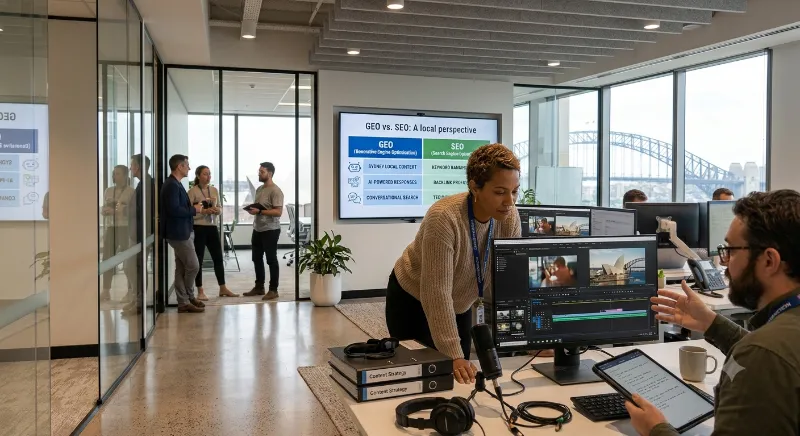
SEO is about search visibility. GEO is about answer visibility.
SEO helps your website appear in search results. GEO helps your business appear inside AI-generated responses.
The difference matters because user behaviour is shifting. People are increasingly asking longer, more specific and more conversational questions.
A traditional SEO query might be:
“SEO agency Sydney”
An AI search query might be:
“What is the best SEO agency in Sydney for a small business that wants more leads but has a limited budget?”
That second query requires a different content strategy. The AI system is not simply matching keywords. It is trying to understand context, compare options, identify trustworthy sources and generate a useful answer.
SEO vs GEO Comparison Table
| Area | SEO | GEO |
|---|---|---|
| Main goal | Rank in search results | Appear in AI-generated answers |
| Primary platforms | Google, Bing | ChatGPT, Gemini, Claude, Perplexity, AI Overviews |
| Content focus | Keywords and relevance | Entities, answers and authority |
| Success metric | Rankings, traffic, clicks | Citations, mentions, recommendations |
| Structure | Pages, headings, internal links | Clear answers, schema, citations, summaries |
| Best for | Search visibility | AI search visibility |
| Still needed? | Yes | Yes |
Why Sydney Businesses Need Both in 2026
Sydney is one of Australia’s most competitive business markets. Whether you run a trade business, medical clinic, legal practice, ecommerce store, hospitality venue or professional service company, your customers are comparing options online before contacting you.
In 2026, those comparisons may happen before users reach your website.
A potential customer may ask an AI assistant:
- “Which Sydney web design agency is best for small businesses?”
- “What should I look for in a local SEO consultant?”
- “How much does SEO cost in Australia?”
- “Is GEO more important than SEO?”
- “Which digital agency can help my business appear in AI search?”
If your business has weak content, unclear positioning, poor technical SEO, no authority signals and limited online mentions, AI systems have less reason to include you.
That is why SEO and GEO should not be treated as separate strategies. GEO builds on SEO.
Strong SEO gives AI systems a clearer foundation to understand your business.
How Google AI Overviews Changed the Search Landscape

Google AI Overviews are designed to give users a faster summary of complex topics, while still offering links for deeper exploration. For businesses, this means content that clearly answers specific questions may have a better chance of being surfaced in AI-assisted search experiences.
This does not mean every article will appear in AI Overviews. Google still relies heavily on quality, relevance, crawlability and trust signals.
But it does mean your content should be written in a way that is easy for both humans and machines to understand.
That includes:
- Clear definitions
- Concise answers
- Strong heading structure
- Practical examples
- Original insights
- Authoritative references
- Structured data
- Internal links
- Local context
What GEO Means for Local Sydney SEO
For Sydney small businesses, GEO should start with local clarity.
AI systems need to understand:
- Who you are
- What you do
- Where you operate
- Who you serve
- What makes you credible
- What services you provide
- How people can contact you
- Why your business is relevant to a specific query
For example, instead of writing a generic page titled “Digital Marketing Services”, a Sydney business should be more specific:
“Digital Marketing Services for Small Businesses in Sydney”
This gives search engines and AI systems stronger context.
The same applies to blog content. A generic article like “Why SEO Matters” is less useful than:
“Why SEO Matters for Sydney Small Businesses in 2026”
Specificity helps both users and AI systems.
Practical Example: A Sydney Small Business Scenario
Imagine a small home renovation company based in Inner West Sydney.
Their old SEO strategy focuses only on ranking for:
- home renovations Sydney
- bathroom renovations Sydney
- kitchen renovations Sydney
That is useful, but limited.
A GEO-aware strategy would also create content that answers questions like:
- What should Sydney homeowners know before renovating?
- How long does a bathroom renovation take in NSW?
- What questions should you ask a renovation contractor?
- What is the difference between budget and premium renovation work?
- How do you compare renovation quotes?
This content helps the business show expertise. It also gives AI systems clearer material to summarise, cite or recommend.
The goal is not to trick AI. The goal is to become genuinely useful enough to be included.
Key GEO Signals Sydney Companies Should Build
1. Clear Entity Identity
Your business should be easy to understand as an entity.
That means your website should clearly show:
- Business name
- Location
- Services
- Industry
- Team or expertise
- Contact details
- Service areas
- Case studies or examples
- Reviews or testimonials
If your site is vague, AI systems may struggle to understand what your business actually does.
2. Strong Service Pages
Every major service should have its own dedicated page.
For example, Faraz Agency could benefit from pages such as:
- SEO Services Sydney
- GEO Services Australia
- Web Design for Small Businesses
- AI Search Optimization
- Digital Strategy for Small Businesses
Each page should answer real buying questions, not just list features.
3. Helpful Blog Content
Blogs are important for topical authority.
A strong blog strategy should answer questions your customers are already asking.
Examples:
- What is GEO?
- Is SEO still worth it in 2026?
- How can small businesses appear in AI search?
- What is the difference between SEO and AI search optimization?
- How do Sydney businesses choose a digital agency?
4. Structured Data
Schema markup helps search engines understand your website more clearly.
Recommended schema types include:
- Organization Schema
- LocalBusiness Schema
- Article Schema
- FAQ Schema
- Breadcrumb Schema
- Service Schema
Schema does not guarantee rankings or AI visibility, but it improves machine readability.
5. Trust Signals
AI systems are more likely to rely on sources that appear credible.
Trust signals include:
- Clear author information
- Real business address
- Contact details
- Case studies
- Reviews
- External mentions
- Consistent branding
- Updated content
- Transparent service descriptions
Common Mistakes Sydney Businesses Make
Mistake 1: Treating GEO as a Replacement for SEO
GEO does not replace SEO. It depends on it.
If your website cannot be crawled, loads slowly, has thin content or lacks clear structure, your GEO potential will be limited.
Mistake 2: Writing Generic Content
Generic content is weak for both SEO and GEO.
An article titled “Why Marketing Is Important” is too broad. A better article would be:
“Why Local SEO and GEO Matter for Sydney Small Businesses in 2026”
Specific content is easier to rank, easier to extract and more useful for customers.
Mistake 3: Ignoring Local Context
Sydney customers have local needs. A plumber in Sydney, a café in Bondi, and a law firm in the CBD should not use the same generic digital strategy.
Mentioning relevant suburbs, service areas, local challenges and Australian business context helps improve relevance.
Mistake 4: Publishing Without Structure
AI systems prefer content that is easy to parse.
Use:
- Descriptive headings
- Short paragraphs
- Tables
- FAQs
- Definitions
- Step-by-step checklists
- Clear summaries
Mistake 5: Not Building Authority
One article is not enough.
To build topical authority, your site needs a cluster of related content around SEO, GEO, AI search, local search and digital growth.
Practical GEO Checklist for Sydney Companies
Use this checklist to improve your visibility in both SEO and AI search.
Website Foundation
- Make sure your website is crawlable
- Improve page speed
- Use HTTPS
- Fix broken links
- Optimise for mobile
- Add clear navigation
Content Structure
- Add a quick answer section to key articles
- Use clear H2 and H3 headings
- Include FAQs
- Add comparison tables
- Explain terms clearly
- Use Australian English
Local Signals
- Mention Sydney and relevant service areas
- Optimise Google Business Profile
- Keep NAP details consistent
- Add local testimonials
- Create location-specific service pages
Authority Signals
- Add author or agency expertise
- Reference trusted sources
- Publish original insights
- Add case studies where real data exists
- Keep content updated
AI Search Optimisation
- Define key concepts clearly
- Use entity-rich language
- Add schema markup
- Create concise summaries
- Answer conversational questions
- Build content clusters
Expert Insights: The Future Is Search Everywhere
The biggest mistake businesses can make in 2026 is thinking search only happens on Google.
Search now happens across:
- AI assistants
- Social platforms
- YouTube
- Maps
- Review platforms
- Marketplaces
- Voice assistants
For Sydney small businesses, this means visibility must be multi-layered.
Your website is still the centre of your digital presence, but it needs to be supported by reviews, social proof, structured content, local signals and consistent brand information across the web.
GEO is not a shortcut. It is a visibility strategy for a search environment where answers are generated, not just listed.
FAQ
1. Is GEO replacing SEO?
No. GEO is not replacing SEO. It extends SEO. Businesses still need strong technical SEO, quality content, internal links, authority and local optimisation. GEO adds another layer focused on AI-generated answers and citations.
2. What does GEO stand for?
GEO stands for Generative Engine Optimization. It focuses on improving how your business, content and expertise appear in generative AI search results.
3. Is SEO still important in 2026?
Yes. SEO is still important because AI search systems often rely on indexed, structured and authoritative web content. Strong SEO improves the foundation for AI visibility.
4. Can small businesses in Sydney benefit from GEO?
Yes. Sydney small businesses can benefit from GEO by creating clear, helpful, locally relevant content that answers real customer questions and builds authority.
5. How is GEO different from local SEO?
Local SEO helps businesses appear in local search results and map listings. GEO helps businesses appear in AI-generated answers. The best strategy combines both.
6. Does GEO require technical changes?
Yes, in some cases. GEO can involve schema markup, improved site structure, better internal linking, clearer service pages and more machine-readable content.
7. Can AI search engines recommend my business?
Potentially, yes. AI systems may recommend businesses when they can identify relevance, credibility and strong supporting information across trusted sources.
8. What type of content works best for GEO?
Clear, expert, structured and useful content works best. FAQs, comparison guides, checklists, definitions, case studies and locally relevant guides are especially useful.
9. Should every Sydney business create GEO content?
Any business that depends on online discovery should consider GEO. This includes professional services, trades, ecommerce, clinics, agencies, hospitality businesses and local service providers.
10. How long does GEO take to work?
GEO is a long-term visibility strategy. It depends on your existing SEO foundation, content quality, brand authority and how clearly your business is represented online.
11. Do backlinks still matter for GEO?
Yes. Backlinks and brand mentions can support authority. However, GEO also depends on clarity, structure, expertise and answer quality.
12. What is the first step for GEO?
Start by auditing your current website. Identify whether your services, location, expertise, FAQs, schema and internal links are clear enough for both users and AI systems.
Conclusion
SEO and GEO are not enemies. They are two parts of the same visibility strategy.
SEO helps your Sydney business rank in traditional search results. GEO helps your business become visible in AI-generated answers, summaries and recommendations.
In 2026, small businesses that rely only on old SEO tactics may lose visibility as customer behaviour changes. But businesses that combine strong technical SEO, helpful content, local relevance, authority signals and AI-friendly structure will be better positioned for the future of search.
If your customers are asking better questions, your website needs to provide better answers.